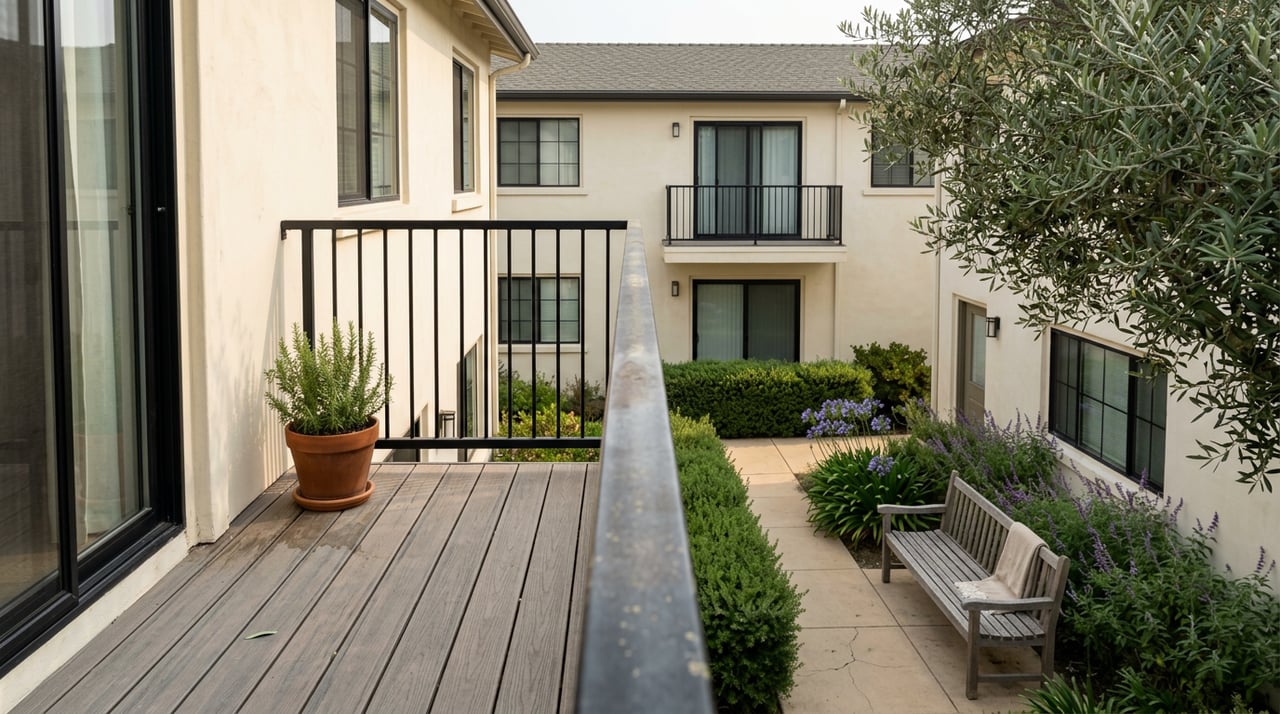
A Rivermark townhome seller can price a listing in an afternoon. Comps are easy to pull, the neighborhood is well documented, and the numbers write most of the description themselves. The document that can actually slow the sale down, or reopen the price after an accepted offer, isn't the comp sheet. It's a structural inspection report that may or may not exist, may or may not have been shared with the board, and as of this year has to be handed to the buyer before closing.
That report comes from Senate Bill 326, California's balcony inspection law for condominium associations. The law itself isn't new. What changed is what happens to the paperwork once it exists, and that shift lands differently depending on which Santa Clara market you're selling into.
Two Deadlines, One Common Mix-Up
California actually has two balcony laws, and HOA boards mix them up constantly. SB 326 covers condominium associations. SB 721 covers apartment buildings owned by landlords. They sound similar and share an origin story, the 2015 Berkeley balcony collapse that killed six people, but they run on different clocks.
| SB 326 (condos) | SB 721 (apartments) | |
|---|---|---|
| Property type | Condominium HOAs, 3+ units | Rental apartment buildings, 3+ units |
| First inspection deadline | January 1, 2025, no extension | January 1, 2026, extended from 2025 |
| Re-inspection cycle | Every 9 years | Every 6 years |
| Who can inspect | Licensed structural engineer, architect, or civil engineer (civil engineers added by AB 2114) | Broader pool including certified building inspectors |
The mix-up matters because plenty of condo boards heard about the SB 721 extension to 2026 and assumed it applied to them too. It doesn't. If a Santa Clara condo HOA is only now getting around to its first inspection, that association isn't early. It's already more than a year past its statutory deadline.
What Changed for Sellers on January 1, 2026
For the first four years SB 326 existed, the inspection report was mostly an internal HOA document. Boards commissioned it, filed it, and folded any findings into the reserve study under Civil Code Section 5550. Homeowners could request a copy, but nothing forced it into a transaction.
That changed this year. Under the disclosure requirement that took effect January 1, 2026, HOA boards now have to include the most recent exterior elevated element inspection report in the seller disclosure package. If the inspection turns up an immediate safety hazard, the association has to restrict access to the affected area and notify local code enforcement within 15 days, and the report itself has to be kept on file for 18 years.
The practical effect for a seller is simple. If your HOA has a clean report, that report is now working in your favor and belongs in front of buyers early. If your HOA never completed one, the absence is itself a disclosure item, and a buyer's agent who knows what SB 326 is will ask about it before writing an offer.
Why the Timing Bites Harder in a Softer Condo Market
Here's the part that gets missed in most explanations of this law: the disclosure requirement didn't create buyer leverage on its own. The market did that, and it's doing it right now specifically in the condo segment, not across Santa Clara housing generally.
Santa Clara's overall housing market is still moving fast. Over the three months ending May 2026, the city ranked among the most competitive Redfin tracks, with the typical home fielding around four offers and selling in about 12 days. That pace is driven largely by the detached homes that dominate the city's sales volume, and it's not a market where anyone stops to read a structural report before writing a competitive offer.
Condos tell a different story, and the most recent granular numbers available come from the countywide market rather than the city alone. Across Santa Clara County, the median condo sale price sat flat at $970,000 in April 2026 compared to a year earlier, the typical condo took 31 days to sell that same month, and condo inventory was up 14.7% year over year. Santa Clara's own condo stock, concentrated in communities like Rivermark, sits inside that countywide pattern. That's a segment with room to browse, room to compare, and room to actually open a disclosure package before deciding whether to write an offer at all.
That gap is the real mechanism. A buyer competing for one of Santa Clara's fast-moving detached listings doesn't have time to dig into an HOA's paperwork before someone else takes the house. A condo buyer, working in a slower, more crowded segment, does have that time. The law gave that buyer something concrete to look for. The market gave them room to actually look for it.
Not Every Santa Clara HOA Even Has This Obligation
Here's a nuance that trips up sellers who assume every attached home in an HOA is automatically covered: SB 326 applies to condominiums, meaning the association owns or is contractually responsible for maintaining the exterior structure. It does not apply to planned developments, where individual owners hold title to their own exterior walls and roof and are personally responsible for their own balcony or deck.
Whether a given property is legally a condominium or a planned development under the Davis-Stirling Act depends on how the CC&Rs define unit boundaries, not on what the building looks like from the street. Two townhomes that look identical from the sidewalk can sit under two completely different disclosure obligations.
This matters concretely in Santa Clara because so much of the city's condo and townhome inventory sits in Rivermark, the 152-acre master-planned community developed in 2003 on the north side of the city, with roughly 1,900 properties spread across named sub-communities including The Arbors, The Park, The Promenade, and The Greens II, plus the separately governed Toscana at Rivermark association. Product built in 2003 falls well before the January 1, 2020 cutoff that gives newer condo projects a six-year grace period tied to their certificate of occupancy. Anything in that vintage that qualifies as a true condominium should already have completed its first SB 326 inspection well before this year, not be waiting on one.
Before assuming your HOA does or doesn't owe you a report, check your governing documents or ask your HOA management company directly which category your property falls into.
What the Report Actually Says, and What It Costs If It's Bad
When an inspection does happen, the findings get sorted into one of three categories: immediate safety hazard, needs repair within a defined timeline, or satisfactory condition. It's the middle category that most often reshapes a sale.
Industry reporting on completed inspections across the state points to per-balcony repair costs typically running $10,000 to $25,000, with full reconstruction in high-cost markets like the Bay Area reaching $40,000 to $60,000 per unit. One California HOA attorney has reported seeing special assessments as high as $175,000 per unit in the most severe cases. Insurance carriers are paying attention too. Some are now requiring proof of a completed inspection before renewing a policy, and non-compliant associations have reported premium increases as high as 300 percent.
None of that means every Santa Clara condo with balconies is sitting on a hidden liability. Plenty of associations completed their inspections on schedule and came back clean. But a seller who doesn't know which category their building falls into is walking into a negotiation blind, and in a condo market with 31 days of average marketing time, buyers have every reason to ask before they'll commit.
Before You List a Santa Clara Condo This Year
A few questions worth answering before you put a condo or townhome on the market:
- Ask your HOA board or management company for the most recent SB 326 inspection report, and confirm one actually exists.
- Check your CC&Rs to determine whether your property is legally a condominium or a planned development, since that determines whether SB 326 applies at all.
- If a report exists, confirm whether its findings were incorporated into the reserve study, as Civil Code Section 5550 requires.
- Ask whether the board has discussed or scheduled a special assessment tied to any findings.
- If your HOA hasn't completed an inspection, decide how you'll address that with buyers before their agent raises it first.
None of this is legal or financial advice, and questions about your specific HOA's obligations, CC&Rs, or reserve study should go to your association's attorney or a licensed structural engineer, not a real estate agent's blog post.
A Short FAQ
Does SB 326 apply to my townhome if it's part of an HOA? Only if your property is legally a condominium under the Davis-Stirling Act, meaning the association owns or maintains the exterior structure. If your CC&Rs define your unit as a planned development, SB 326 doesn't apply and there may be no report to disclose.
My HOA finished its inspection back in 2025. Does the 2026 change still affect me? Yes. The 2026 change isn't about whether the inspection happened. It's about whether the report has to go into the buyer's disclosure package. A completed, clean report is good news for a seller, but it still has to be produced and shared.
What if the report finds a problem right before I'm ready to list? Talk to your HOA board about timeline and next steps before you set a list price, not after. A known repair plan and funding source reads very differently to a buyer than an open-ended problem with no answers attached.
Does any of this apply to single-family homes? No. SB 326 is specific to condominium associations with shared, HOA-maintained exterior elevated elements. A single-family home, even one inside an HOA, isn't covered unless the association itself owns a shared balcony or walkway structure.
If you're weighing a sale in Rivermark, Toscana, or another Santa Clara condo community and want to understand where your specific HOA stands before you list, that's exactly the kind of groundwork Team NL Homes helps clients sort through, alongside the structural engineers, HOA attorneys, and property managers who can give you real answers. Schedule A Consultation and let's look at your building's paperwork together before a buyer does.